

Sounds in Language
Introducing Beginning Sounds
As children play with sounds in language, they begin to understand that there are letters of the alphabet that are used to spell those sounds. Songs, games and nursery rhymes give children a chance to discover the joy and excitement of the words that they hear and speak. These activities also prepare them for learning to read and write.
- By age 4, children develop rhyme and syllable awareness. For example, they can tell you that chairs rhymes with bears. They can also tell you that their name, Rylee, has 2 claps: Ry – lee. (A clap is also called a syllable).
- By age 5, they can identify words that have the same first sound. For example, they can tell you that Mommy and moon begin with the sound /mmmmm/.
The following activities will help prepare your child to think about words in spoken language.
Rhyming Activities
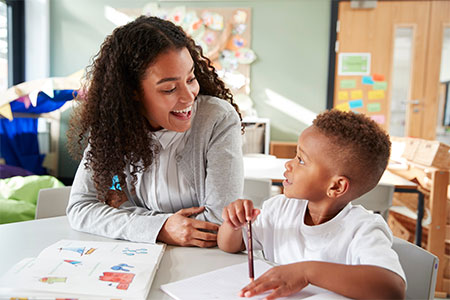
Sing rhyming songs, read rhyming stories, and recite nursery rhymes
When you get to the rhyming words emphasize them.
Jack and Jill
went up the hill
to fetch a pail of water
Jack fell down
and broke his crown
and Jill came tumbling after

Fill in the rhyming word
With repetition your child will eventually become familiar with the rhymes. Once that happens, let them fill in the rhyming word.
Jack and Jill
went up the ____
Humpty Dumpty sat on a wall
Humpty Dumpty had a great ____
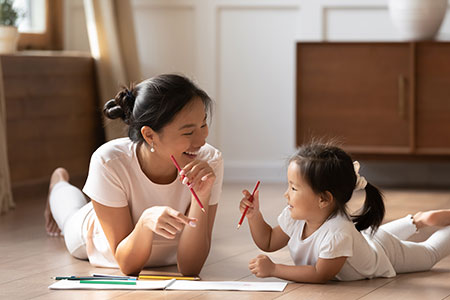
Play silly rhyming games
As your child becomes familiar with rhyming, try these options.
Rhyme your child’s name with a real or pretend word that starts with a different letter. For example: David Bavid, Brookie Cookie, Juan Don.
Or say a simple word your child is familiar with and ask them for a word that rhymes. Their words don’t even have to be real words.
You say “cat”; they may say “hat”; you say “bat”; they may say “pat” or “lat”. Keep the game going as long as the real or pretend words rhyme, then start all over with a new word.
Counting Syllables
Explain to your child that words are made up of “big chunks” of sounds called syllables. Some words such as cat and dog have one chunk; others have two chunks, such as bunny and mommy; and some even have three or more chunks, such as banana and watermelon. Use this activity to help your child learn to listen for chunks of sounds (syllables):
Clap out syllables
Using words that are familiar to your child, clap out the number of syllables together. To make sure they understand, give one or two examples. Say the word slowly and clap for each syllable.
/cat/ (clap)
/ti/ (clap), /ger/ (clap)
/ba/ (clap), /gel/ (clap)
Using the method you demonstrated, together with your child, clap out several words with different numbers of syllables.
Kids love to clap and will want to play this game often. Having them clap out the syllables in their name (and the names of others they know) will be especially fun!
Here are some words to get you started. Add your own as play continues.
bat, hat, cat, dog, log, cow
toothbrush, twinkle, sister, brother
animal, dinosaur, butterfly, potato, lemonade
Beginning Sounds
Another way to prepare your preschooler to learn to read is to play with the sounds of words. Focusing on the first sound in words will help your child pay attention to the sounds that their mouth makes and help them to learn the sounds that go with letters later on. Following are several activities to encourage this skill:
Stretchy sounds
Begin with sounds that you can stretch out. For example, you can stretch out /sssssss/ in sun and soap, and you can stretch out /mmmmm/ in milk and mommy. These sounds are easier for children to separate from the rest of the word.
Prompt your child to “Say a little bit of sssssss-oap.” “Say a little bit of mmmmm-ommmy.” Other sounds to try this with include /ffffffff/ (as in ffffff-riend), /jjjjjj/ (as in jjjjjj-ump), and /rrrrr/ (as in rrrrr-uby)
Tongue ticklers
Play with one sound over and over again. Here are some examples: For /m/: Mister Mouse makes a mess munching on melted marshmallows.
As you say each of the words that begin with /m/, be sure to say each of those words slowly and loudly.
If your child is successful with this one, you can try a tongue tickler that has a different kind of sound at the beginning of the words.
For /p/: Peter Piper picked a peck of pickled peppers.
I Spy
Display several objects or picture cards on a table (sock, sun, suitcase, milk, monkey, mitten).
You say, “I spy with my little eye something that begins with the sound /mmmmmm/,” and ask your child to pick up a picture card with that sound.

Pro Tip
Play these basic building block word games often with your child. Mixing in new rhymes, words, or sounds with familiar ones is a fun and educational way to help them learn that words are made up of sounds—an important pre-reading skill that will help prepare them to learn to read.
Pro Tip
If your child has difficulty with rhyming, you can still play the syllable and beginning sounds games.
Beginning Sounds
- Rain Play, by Cynthia Cotton
- Piggies in the Pumpkin Patch, by Mary Peterson and Jennifer Rofe